
Application points of Premium Technologies technologies in infrastructure projects
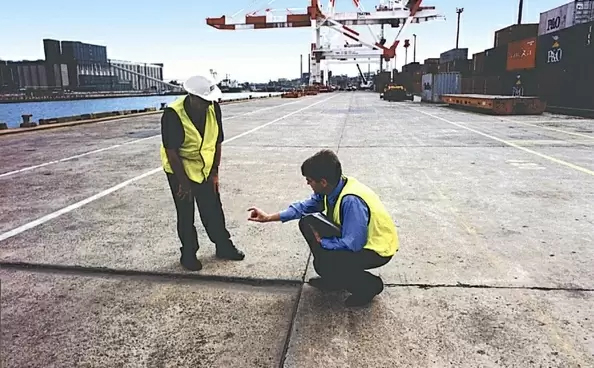
Premium Technologies has extensive experience in transportation and infrastructure projects, delivering successful results through the development of customized technical solutions. We re-level and reinforce concrete slabs and pavements, bridges and access roads, roads and railways, airports and seaports, pipelines, buildings and other structures. We also fill holes, voids and abandoned pipes, provide technologically advanced solutions to “revive” aging infrastructure and restore sewer branches. Thanks to our non-invasive methods, the inconvenience of operating the repaired area is minimized. The work can be carried out day or night and is scheduled in such a way as to ensure uninterrupted traffic, rail or air operations. Large-scale projects can usually be completed in parts (as part of the global project) and divided into “temporary windows”. CULVERTS AND UNDERGROUNDS Most steel culverts and underpasses have reached the end of their service life, and asset managers face the inevitable costs and losses of dismantling and replacing aging infrastructure. Premium Technologies has extensive experience in the rehabilitation of culvert and underground structures. Combining our expertise in protective coatings and polymer solutions, our specialists work with the asset owner to identify and then provide the optimal rehabilitation solution. ROADS, RAILWAYS AND PORTS As road, rail and port infrastructure ages, they become increasingly vulnerable to damage caused by increasingly heavy loads and dynamic loads from cars, trucks, trains and even forklifts. Repeated and intense mechanical vibrations combined with heavy rain or poor drainage can weaken the foundation beneath transportation corridors, leading to instability and the formation of lower voids. The resulting unevenness of road surfaces, railway lines and runways can pose a serious safety and operational inconvenience. Premium Technologies raises, restores and extends the service life of damaged infrastructure. We also carry out underground infrastructure conservation and void filling. The work is carried out cost-effectively to minimize downtime. UTILITIES (WATER / WASTEWATER) Repairing aging and damaged infrastructure is often more cost-effective than replacing it. Premium Technologies uses proven ground engineering solutions and asset rehabilitation techniques to help owners and users extend the service life of utilities. We restore assets for electricity, gas, waste management, telecommunications and water utilities. Our solutions typically eliminate the need for excavation, with minimal disruption. When preparing for the decommissioning or abandonment of underground assets, our engineers provide cost-effective alternatives to excavation and demolition. Depending on the complexity of the project, our specialized solutions will be developed and tested to meet the unique requirements of the facility.
Strengthening and leveling of piers, ports and embankment surfaces
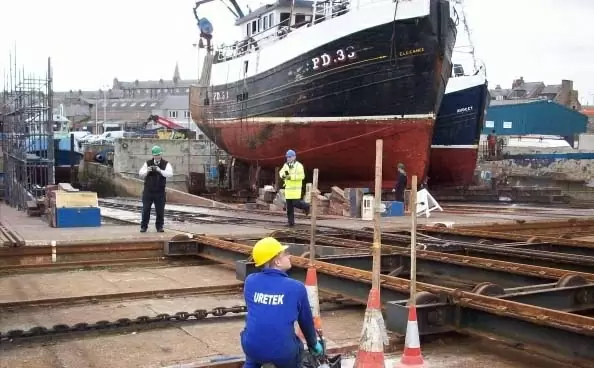
Geopolymer resins do not come into contact with water and are able to maintain a stable state in a humid environment for a long time. These qualities allow the use of geopolymers for lifting, leveling and stabilizing port infrastructure. Modern Premium Technologies technologies are used for lifting and stabilizing concrete pavements in sea and river ports. In this case, injection is possible not only directly under the concrete slabs of piers or embankments, but also into the soil of the base of structures, which is characterized by water saturation. SOIL REINFORCEMENT UNDER BERTHS AND EMBANKMENTS The design of concrete piers and quays involves the installation of a vertical retaining wall, behind which a layer of soil is poured for the installation of concrete coatings. Due to the influence of sea or river water, the groundwater level periodically changes, and with it the moisture content of the soil of the base of the structure. This leads to the gradual compaction of the bulk soil and subsidence of the horizontal surfaces of piers and quays. At the same time, trucks, loaders, conveyor belts, gantry cranes and other equipment continuously move along the horizontal surfaces of port infrastructure facilities. Port coatings are exposed to high dynamic loads. For example, 60-ton portal loaders can carry containers weighing up to 40 tons. All this creates excess pressure on horizontal surfaces and increases the degree of soil compaction, which provokes an increase in the subsidence of concrete surfaces. To stabilize the structures of piers, ports and embankments, compaction, strengthening and stabilization of bulk soil and the soil of the structure’s foundation are carried out by injecting geopolymer materials. At the same time, it is not necessary to stop the port’s operation to lift and level concrete slabs. LIFTING AND LEVELING OF CONCRETE PORT COVERINGS The use of Premium Technologies technology in marinas and ports can include strengthening heavy-duty parking areas and gantry crane and forklift areas. It is also possible to repair concrete floors and level sagging warehouse floor slabs, and strengthen sagging or washed-out underlying soil layers. Floor Lifting technology allows you to raise and level concrete slabs. In addition, to increase the bearing capacity of soils, the Deep Lifting method is used. In this case, the hemipolymers displace “excess” water from the moistened soil and strengthen and reinforce the soil. ADVANTAGES OF Premium Technologies METHODS The traditional method of restoring concrete slabs covering port facilities involves dismantling the slabs, compacting the bulk soil, and then reinstalling the reinforced concrete coating. In fact, we are talking about re-erecting the structure. In addition to a significant financial burden, this approach forces the facility to be temporarily taken out of operation, which leads to additional losses due to the downtime of the port infrastructure elements. When using Premium Technologies technology, neither the facility is taken out of operation nor the dismantling of the coatings is required. All materials and equipment in this case are placed in one truck, which allows the work to be carried out in stages in different areas. For injection, it is only necessary to drill a series of technological holes with a diameter of 12-16 mm. The areas where restoration operations are performed are fully ready for return to operation just 15 minutes after the completion of the work.
Leveling and lifting concrete floors of industrial and administrative buildings
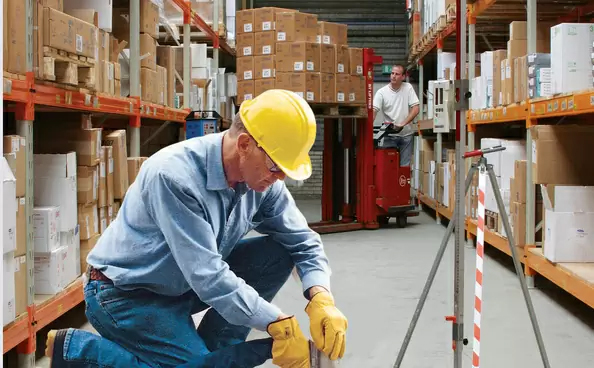
The concrete floor of the first floor of utility and production premises may begin to sag. Deformation and skewing of individual concrete slabs, damage to concrete elements at joints, etc. are also possible. To repair and level the concrete floor, it is not necessary to interrupt the production process and dismantle the equipment. If the floor of the first floor of a utility or production premises is made of concrete slabs, subsidence of individual elements is permissible within certain limits. All preparatory work when arranging the floor must be done at a high level, otherwise after some time of operation the premises will require repair of concrete floors. Heavily subsided and unstable concrete elements, as well as sagging or damaged edges of the slabs will interfere with the normal course of production processes. CONCRETE FLOOR REPAIR To eliminate the deformation of the concrete floor, to raise and level the position of individual concrete slabs of the first floor floor, it is possible using the Floor Lifting technology. The work can be carried out in the shortest possible time, without dismantling the equipment. This saves time and money, which is impossible when using outdated methods of repairing concrete floors. At the same time, when repairing concrete floors using the Floor Lifting technology, the load on the concrete floor is not a disadvantage, but rather an advantage. Sometimes it makes sense to first install new equipment, and only then perform work on correcting the level of the concrete floor. With significant weight loads, it is easier to direct maximum efforts when injecting geopolymers into lower soil layers. The soil is compacted under a given load, which will allow you to obtain a more stable floor surface. CONCRETE FLOOR LEVELING TECHNOLOGY When repairing a concrete floor using Floor Lifting technology, problem areas of the floor can be put into operation as quickly as possible. Downtime and costs associated with removing and replacing concrete floors are virtually non-existent. And the technology itself has minimal impact on the customer’s business processes. In order to align the horizontal position of the concrete slabs, a series of geopolymer injections are carried out directly under the slab through holes with a diameter of 8-12 mm. The constituent components of the material are mixed on special equipment, the chemical reaction of the expansion of geopolymers begins almost instantly. The geopolymer material fills cavities and voids, expands and compacts the weak bearing capacity layers of the soil under the slab. Soil compaction occurs within a radius of 0.50 m from the injection site, and with the further introduction of geopolymers, a layer with bearing capacity is formed, which becomes a support point for lifting the concrete floor slab. The lifting process is controlled and monitored during the work. The lifting accuracy is ± 1 mm. After the work is completed, the injection holes are closed. REPAIR OF COLD ROOM FLOORS Special requirements are made for thermal insulation of refrigerated warehouses. In order to maintain a sub-zero temperature inside the room, such structures are specially insulated on all sides, including not only the walls and ceiling, but also the floor. If it is necessary to convert an existing warehouse into a refrigerated warehouse that is not equipped with reliable thermal insulation, geopolymers can also be used to level and insulate the floor or concrete slab foundation. During injection, two tasks are solved here. First, the soil is strengthened and compacted, which makes it possible to prepare the floor of the first floor for increased loads. Secondly, an additional layer of geopolymers under the foundation or floor of the first floor acts as a thermal insulation material. In this case, there is no need to incur additional costs for arranging thermal insulation of the floor of the refrigerated warehouse.
Waterproofing and repair of underground structures
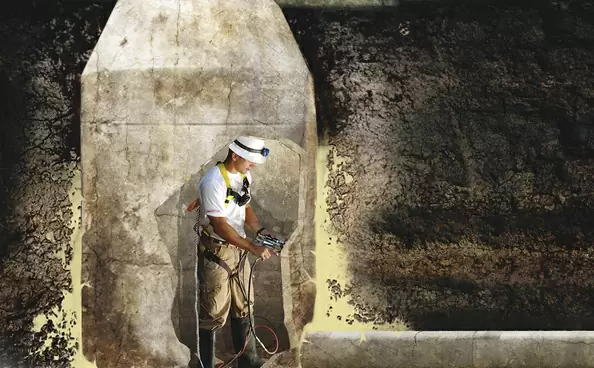
The characteristics of geopolymer resins allow them to be used for strengthening and waterproofing various underground structures. These include objects such as collectors, pipeline shafts, wells, fuel tanks, underground tanks, basement structures, etc. If during the operation of an underground structure, the walls of which must ensure complete tightness, cracks appear or a liquid leak occurs, it is necessary to carry out urgent repairs to the object. However, in many cases, it is not enough to simply eliminate cracks, replace damaged elements and restore the waterproofing properties of the walls of the structure. If the structure has leaked liquid, most likely, there has been a dilution, a decrease in compaction and weakening of the soil in which the object is located. Therefore, to restore the structural characteristics of the object, it is often necessary to also increase the density of the soil where the structure is located, that is, to strengthen and consolidate the diluted soil. The easiest way to do this is with the help of Premium Technologies geopolymer resins. WATERPROOFING OF MINES AND TUNNELS Underground structures such as tunnels, pipelines and shafts can be made of prefabricated elements. For waterproofing and sealing of such structures, it is necessary to reliably seal the joints and seams between the elements. Gelopolymer resins can also be used to seal the seams, which are injected into the joints of the elements. Seams and cracks in the walls of underground structures can be sealed both from the surface of the earth, without the need to excavate the structures, and, if there is a possibility of personnel access, from inside the objects. When injecting geopolymers into the place of contact of the outer surface of the tunnel or shaft with the soil, the expanding material can even get inside the object, which will indicate the reliability of the work performed. In this case, the excess material is simply cut off from the inside of the structure and all internal surfaces are cleaned. REDUCTION OF SOIL MOISTURE CAPACITY One of the reasons for the violation of the waterproofing of underground structures (basements, foundations, etc.) is the insufficient hardness of the soil adjacent to the walls of the structure. Loose soil around the perimeter of the structure can sag and absorb excess moisture, as a result of which the external walls below the ground level will get wet. To stop this process, geopolymer resins are injected into the thickness of the loose soil of the backfill. This makes it possible to increase the density and strengthen the soil, which will reduce its moisture capacity. An indirect consequence of such a procedure is also the waterproofing of the structure.
Premium Technologies on the front line of preserving world cultural heritage
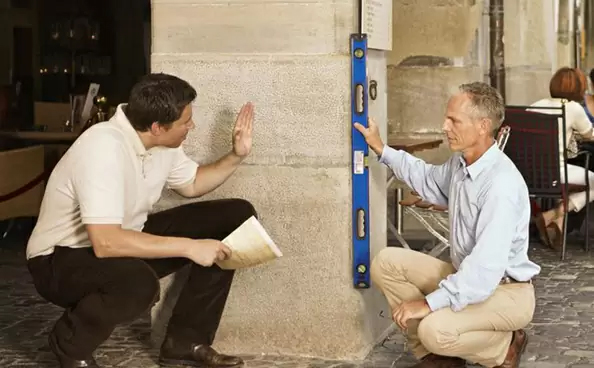
Buildings of high historical and cultural value are subject to natural aging and destruction. At the same time, the restoration, reconstruction or reconstruction of national and world heritage sites should be carried out with minimal damage to structures, whether it is repairing walls and floors, or raising and strengthening the foundation. Damage to historical structures can be minimized by using Premium Technologies geopolymer technologies. Manors and palaces, castles and fortresses, churches and temples, as well as many other historical sites are gradually aging and collapsing. The condition of walls, roofs and ceilings of buildings is negatively affected by continuously changing environmental factors – pressure, temperature, humidity and air pollution. No less dangerous for historical sites can be a change in the characteristics of the soil on which the structure is built. Thus, weakening of the foundation soil can cause subsidence of the first floor floor or affect the stability of the foundation, and therefore other structural elements of the building. COMPLICATIONS OF SOIL STRENGTHENING Subsidence of foundations and floors of historical objects due to weakening of the soil often provokes the appearance of cracks in the floor and walls of the building. Simple cosmetic repairs of walls and floors in such cases do not save the situation, because they do not eliminate the cause of the appearance of cracks. Therefore, if you do not intervene in the condition of the soil and do not raise the foundation or floor sections to the design level, not only the deterioration of the emergency situation is possible, but also the complete destruction of the architectural monument. Although cultural and historical heritage objects are often restored using the most modern construction technologies and materials, the issues of raising the floor and strengthening the foundation of historical buildings are often solved by traditional methods. However, the use of traditional technologies for strengthening the soil and raising the foundation with the involvement of heavy construction equipment and conducting concrete and earthworks can lead to damage to the historical or cultural value of the object. To eliminate cracks in the floor and walls, as well as to strengthen the soil and raise the foundation or floor of an architectural monument, it is much more effective to use the technology of injection with Premium Technologies geopolymer resins. Their use will not only allow you to do without practically damaging the historical and cultural value of the object, but will also make it possible to significantly reduce the budget for repair and restoration procedures. PROPOSED TECHNOLOGY To strengthen the soil of the base under the foundation of a historical object, as well as to eliminate the subsidence of the floor and foundation, you can use two methods of Premium Technologies geopolymer injection – Deep Stabilization and Slab Lifting. In the first case, a multicomponent geopolymer material for strengthening the soil and raising the foundation is injected to a considerable depth into the soil of the base of the building, and in the second – geopolymers are introduced to eliminate subsidence directly under the floor of the first floor. Geopolymer injection is carried out through special tubes with a diameter of 12-16 mm, which are inserted into wells drilled in the floor of the first floor or in the surface around the perimeter of the building. The diameter of the wells can be from 12 mm to 32 mm. No other technological damage to the object is required. The equipment for injecting geopolymer resins is compact and mobile. Its competent use does not affect the historical or cultural value of the object. The drilled technological holes for injection are easy to close. All restoration procedures using Premium Technologies geopolymer resins, whether it is soil reinforcement, strengthening and lifting the foundation, or eliminating floor subsidence, are performed extremely quickly. After injection, the geopolymer material expands, fills all cavities in the soil and hardens within just 15 minutes, forming vertically directed pressure. At the same time, the degree of lifting of the foundation and floor is monitored in real time using laser levels.
When and how to eliminate subsidence of house foundations
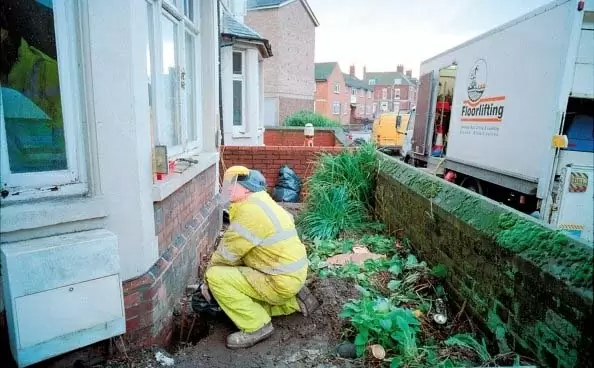
Foundation settlement is a phenomenon that occurs within 3-5 years after the completion of the construction of a building. If the permissible settlement norms are exceeded due to violation of operating conditions, there is a threat of damage and destruction of the structural elements of the building. In this case, settlement is considered subsidence, which must be eliminated. A sign of foundation subsidence is deformation and damage to the structural elements of the building. Cracks may appear in the walls or in the foundation, the floor slabs of the first floor may sag, door and window openings may become warped, etc. When cracks and other deformations are detected, the building is inspected and it is clarified whether only the wall cladding layer is affected or whether there is damage to the supporting structures. If there is damage to the structural elements, and the cause of this damage is excessive foundation subsidence, it is necessary to carry out repair work not only to eliminate the damage itself, but also to eliminate the cause of their appearance. CLASSIC FOUNDATION REINFORCEMENT The traditional way to restore the structural characteristics of a building is to strengthen the foundation. The concept of “strengthening the foundation” itself is very broad. For example, if at the design stage of a house, according to the results of calculations, it turned out that the adopted foundation width is insufficient and the building gives a load greater than the soil can withstand, then it is necessary to recalculate the project with an increased foundation width, that is, “strengthen the foundation”. You can also increase the width of the foundation on a finished object, which entails extensive earthworks and concrete work. Strengthening the foundation of a built house involves a very laborious and lengthy process. To increase the width of the foundation, you need to dig it out along the perimeter of the entire building. However, this cannot be done at the same time due to the risk of destroying the entire structure. With the traditional approach, work on strengthening the foundation is carried out in stages, in small sections. At the same time, it is necessary to understand that the concrete used to increase the width of the foundation gains strength in 28 days. INNOVATIVE SOIL REINFORCEMENT Geopolymer technologies Premium Technologies allow to solve the problem of strengthening the foundation in a different way. The foundation is a structure that transfers the load to the soil. The subsidence of the foundation begins in cases where the pressure on the soil is greater than the standard. The task of stopping and eliminating the subsidence of the foundation can be solved not only by strengthening the foundation, but also by strengthening the soil. In this case, the foundation will remain as it is, and no work will need to be done with it. The fact is that the foundation and the soil are not separate elements, but work in pairs in the form of a soil-foundation system. As soon as the bearing capacity of the soil is increased to the required values, the foundation will begin to function normally. And as a result, we can say that “foundation strengthening” has occurred. FEATURES OF GEOPOLYMER INJECTION Stopping and eliminating foundation settlement by strengthening the soil is carried out by injecting Premium Technologies geopolymer resins. In this case, there is no need for earthworks and concrete works, and all procedures for restoring the characteristics of the structural elements of the building take about two to three days. In order to inject geopolymers, it is necessary to drill holes for pipes with a diameter of 12 mm, through which geopolymers will be injected. In some cases, it is possible to insert two or three pipes into one hole to supply geopolymer material to different depths. All procedures are performed using small mobile tools, without involving large construction equipment.
Lifting and strengthening the foundations of industrial facilities
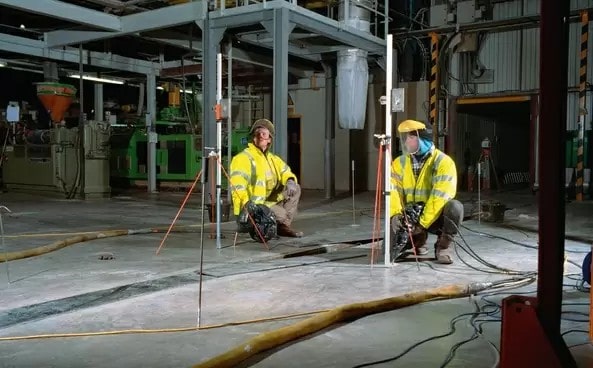
Geopolymer resins have found their application in the field of repair and reconstruction of industrial and manufacturing enterprises. Geopolymers can be used both to strengthen the foundation of existing structures and to modernize premises for the installation of more powerful equipment. Industrial buildings are often subjected to excessive loads during operation. This can be both static loads due to the peculiarities of mechanical production, and continuous dynamic actions and vibrations caused by the production process. Such loads can lead to compaction of the soil under the foundation and the floor of the first floor of the building, as well as to subsidence of individual sections of the foundation under the influence of production mechanisms. The situation can be corrected and the cause of subsidence of the foundation can be eliminated by injecting Premium Technologies geopolymer resins into the soil. STRENGTHENING THE FOUNDATIONS OF OPERATING ENTERPRISES Geopolymer injection works are carried out quickly and with minimal disruption to the production process. For injection, compact mobile units are used, which pump geopolymer material through holes in the floor of the first floor or in the coating (soil) around the perimeter of the building. The process of introducing geopolymers is carried out through small-diameter pipes. The resins harden and the bearing capacity of the foundation increases in a matter of minutes. It is also important that the use of geopolymers to strengthen areas of the foundation and the base soil that are subjected to excessive dynamic loads is very effective. The fact is that these materials have the property of elasticity and are able to restore their volume after the end of excessive dynamic impact. MODERNIZATION OF INDUSTRIAL FACILITIES Reconstruction of old industrial buildings most often implies the need to increase the permissible load limit on the foundation and the floor of the first floor of the building. This must be done when expanding production capacity, purposeful reorientation of the premises, increasing the company’s cargo turnover, etc. After all, most often the installation of more powerful equipment involves a stronger impact on the soil under the foundation. If the premises are not designed for such a load, the soil under the foundation can also be strengthened using the Deep Lifting method. To do this, according to a similar scheme, geopolymers are injected into the base soil to a considerable depth, which leads to strengthening the foundation of the entire structure. Injection is carried out until the soil acquires the necessary load-bearing capacity.